LAST UPDATED
| Status: | Active, open to new members |
Though Sully u3a does NOT have its own Geology Group all members are invited to join the South Wales Network's Group using this link South Wales and Severnside Geology Group
Geosciences Open Day – March 28th, National Museum Cardiff
This meeting was convened in order to bring together geologists from across Wales for the purposes of networking and sharing views on Welsh geodiversity, both now and in the future.
61 geologists gathered in Cardiff by 10.30am and were welcomed by Cindy Howells (President of the South Wales Geologists Association and Curator at NMW). During the morning session, delegates were free to wander around the dozen or so stalls set up by various attendees.
The museum curators also took groups of eight people at a time into the nearby stores for a brief taster of what we have to offer here.
In total, eight such tours were led. Delegates represented all aspects of Welsh geology, from industry, public funded institutions, specialist enthusiast groups, students, geoparks, and honorary research fellows of the museum.
The morning session was an intense networking experience with so many attendees but was a unique opportunity to put faces to well-known names, as well as gathering knowledge of what organisations and research groups were doing what work. A long lunch break allowed chance for all to visit the museum galleries as well as breaking off into small groups to chat about current and future research plans.
The afternoon session started with Cindy thanking everyone for coming along, and then explained thethoughts behind the day. She explained that the museum department now had just three geologists employed, whereas a few decades ago there were over twenty. The same pattern seems to be emerging throughout Wales. No other museums have geological curators, universities are cutting geology courses, and geology in schools is almost extinct. Other public bodies such as Natural Resources Wales and the British Geological Survey are also struggling for funding. Yet geology underpins everything we do and is very popular with children and their families spending time outside in our wonderful countryside. We need to develop ways to support this public interest and bridge the gaps between fossil hunting families and attracting those
children into sciences generally. There are many enthusiast groups, but these are dominated by the older generation, and so need to look at ways to include a wider diversity. Geoscientists in Wales need to pull together and form a better network so that strengths and weaknesses can be identified and addressed.
Lucy McCobb spoke about the international research that is carried out by the museum and the staff, both currently employed and Honorary Research Fellows. Museums hold vastly important collections, which are under appreciated for their taxonomic importance. Few universities teach invertebrate palaeontology in any major way, and apart from various inevitable dinosaurian courses, do not attract much funding either. This
situation is potentially very damaging to the long-term future of palaeontology as specialist knowledge of many groups has already been lost.
Dan Cox talked about the laboratory facilities on offer within the museum and the important mineral and rock collections that we maintain here.
Cindy also read out a statement from former colleague Tom Cotterell who emphasised how the industrial history of Wales is entirely down to its unique geological diversity, and that we mustn’t forget the importance of all other mineral resources just because fossil fuels are being phased out. He reminded everyone that the museum had lost three mineralogy and petrology posts within the last few years, and that this decision had
alienated at least one private collector to the point that his vast and important collection of mineral specimens was donated to the British Geological Survey rather than to the museum.
Brian Williams represented the long-standing Old Red Sandstone research group which has carried out amazing research into the huge thicknesses of this 400-million-year-old deposit across Wales. Numerous PhD students from four different universities have contributed to this research project.
John Nudds, from the South Wales Geologists’ Association explained that the group has around 150 members and represents amateur enthusiasts as well as many academic and industry geologists, both active and retired. He urged all geologists to consider joining such groups.
Keith Nicholls from the North Wales Geologist’s Association mentioned that his career in geology directly resulted from outreach organised by the National Museum in 1971 when he realised that people could get paid for doing geology. He praised the various geological books previously published by the museum. As a community we desperately undersell ourselves and miss out as a consequence.
Tim Astrop from the Brymbo fossil forest project explained how they managed almost all of their work on the site through the actions of volunteers of all ages, who then developed a sense of ownership, and great knowledge of the site. Many younger people were stepping forward to get involved.
J Botting and Lucy Muir spoke on behalf of the Heart of Wales Geopark. There is a perception that Welsh geology has been done, and finished with, whereas discoveries such as this site show that Welsh research is still needed and very active, but needs more recognition.
Alan Bowring represented the Fforest Fawr UNESCO Geopark. He mentioned the other UNESCO landscapes around Wales, all of which, directly or indirectly, have significant links to geology.
Nigel McGaw talked about the Regionally Important Geological Sites (RIGS) groups. There is now only one active group, in Southeast Wales, which is solely run by a small group of enthusiasts and volunteers yet carries out really important work in clearing and producing interpretation of geo-conservation sites and Sites of Special Scientific Importance (SSSI’s).
Lynda Garfield spoke on behalf of the enthusiast and retired geologists who make up so much of the membership of local groups, and the importance of the networking this offers. She feels that society doesn’t understand the importance of geology underlying everything? If we can’t advocate for our own subject’s importance, who can?
Helen Kerbey, from the Mineralogical Society, felt that that networking outside of Wales was probably needed to help with mineralogy education and promotion into Wales.
Elizabeth Hampton, a student from Cardiff University, feels that geology needs far more public exposure and awareness as geology is undergoing exciting opportunities with the energy transition and environmental issues.
Diana Contreras, a lecturer from Cardiff University, spoke about their ongoing project to increase diversity within the STEM network.
Susan Glendinning, of Earth Science Partnership in Taffs Well, spoke about her company; a consultancy of a engineers, geologists, and applied environmental scientists, and how difficult it is now for them to find geological graduates that have the necessary qualifications as many relevant university courses have been cancelled.
David Buchs, senior lecturer from Cardiff University is keen to contribute to research and outreach. He is working on developing a ‘student community-led’ initiative to promote geoheritage and communication in the Cardiff area.
Rhian Kendall, Chief Geologist for Wales, spoke about the resources of the British Geological Survey (BGS), who have their Welsh branch in Cardiff University. Their website provides useful datasets, images and map viewers to allow anyone to access information about British geology.
Chris Byrne and Tom Hughes both spoke on behalf of Natural Resources Wales. Chris talked about the work that NRW did to manage eological sites in Wales, and to provide an essential link with Sites of Special Scientific Interest and landowners. Tom said – “I think a Wales geology network that could reinvigorate RIGS groups, research on Welsh sites and encourage young people to the topic would be massively beneficial, as without it, I wouldn’t be where I am today!”
Melissa Johansson spoke about her company Geode Energy, which provides geological data analysis for oil, gas, water and geothermal industries. In order to engage better with the public, she has recently started filming YouTube clips explaining local geology at a basic level.
Further feedback was given by Elen Wharton of the SE Wales RIGS group whose perception of the state of play within geology had been fairly negative before the meeting as evidenced by cuts to geological staff, difficulties of getting volunteers to help on committees, and the lack of investment in education, meaning that we have to compete with social media and the seemingly low attention span of children. However she was impressed by the enthusiasm shared and talked about during the event, the broad range of attendees, and the willingness for more co-operation between various groups.
Matthew Myerscough, a local geological collector and writer was pleased with the format of dividing the day so that the morning gave opportunities to mingle and chat, whilst the afternoon was given over to talks.
Steve Plant reported on the Russell society - devoted to the collection, identification, reporting and conservation of mineral specimens. Mineralogy has had a strong influence on Welsh geology and the industrialization of Wales. The NMW houses one of the finest collections of minerals found in Wales and represents a huge educational resource which should be encouraged and supported.
Michael Darke has spent many years working in the geoscience industry and finds it disheartening to see geological teaching and expertise disappearing across the UK. He is concerned about how we preserve essential geological skills for the future. Folding geology into broader environmental science degrees does not provide students with clear professional pathways, leaving the discipline's future uncertain.
Sarah Williams attended with a local University of the Third Age (U3A) group. She has an interest in continuing education for older people, and is concerned about the reduction in university, A-level and GCSE courses which may have led to a recently documented loss in science language comprehension and the limited capacity of adults to understand or respond to technical terminology. Also concerned about the
reduction in specialist museum curators given that museums are essential hubs for knowledge and research along with specimen repositories. She was interested in hearing about the successful volunteering opportunities enjoyed by Brymbo, as some groups only offer more menial tasks which don’t lead to feelings of ‘ownership’. She gave thanks for such an intellectually illuminating day, a great privilege to get tours of the mineralogy and palaeontology stores and get up close and personal to some of the local specimens found on
the coast near here.
Overall, the message of the day was that the geological heritage of Wales is something we should all be
fighting to preserve and promote. There have been worrying job losses within the sector, and cuts to
geology educational courses. We urgently need a better geosciences community in order to forge and
maintain a network across Wales rather than working in disparate groups as is the situation now. We
should aim to promote the geology and geological heritage of Wales to public communities, with a view
to inspiring a sense of pride, and even potential income through geotourism in a similar fashion to the
Scottish Geology Trust.
We hope that meetings such as this one held in Cardiff can be continued across Wales to bring together
geoscientists into a more integrated community, better able to assist each other with research, facilities, support and outreach.
Essential museum information:
The National Museum Cardiff opens from 10am - 4pm during winter months and has free entry for all. There is a public car-park at the rear of the building, for which there is a charge of £6.50 each day. There is ramp access to the front door, and internal lifts to access all floors. There is a small cafe in the Main Hall which sells a limited selection of sandwiches, cakes and drinks. External venues for lunch can be found close to the museum, or you are welcome to bring your own lunch.
Link to The Museum of Wales Homepage | Amgueddfa Cymru | Museum Wales
My thoughts on the GEOSCIENCES OPEN DAY - 28th March 2026 - By SH
On Saturday 28th March I tagged along with fellow Sully u3a member Sarah Williams to attend the Geosciences Open Day at Cardiff Museum. My knowledge of geology is extremely limited and of fossils even less, although I do remember an extremely good talk that Cindy Howells gave to Sully u3a a few years back - my records show January 2020 would you believe.
We gathered on the lower level of the museum and after introducing ourselves to the esteemed company of Professors and research fellows we began to walk around the room stopping at each of the display tables to listen to each person talk about the project that they were in involved with. You can read more about these projects in depth in the report that Cindy made which is also on the Geology page. They had all gathered
to network with each other and promote the latest findings of their individual research. Many were retired but still passionate about Geosciences and their own area of expertise and I found it infectious as I gathered up leaflets from each table.
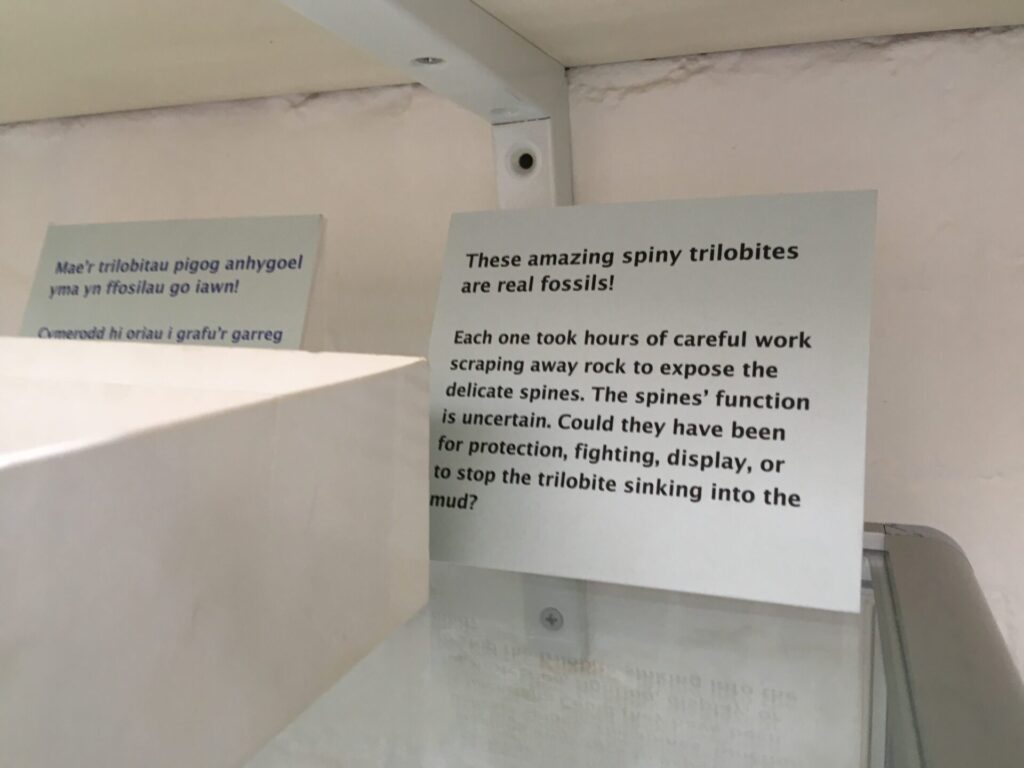
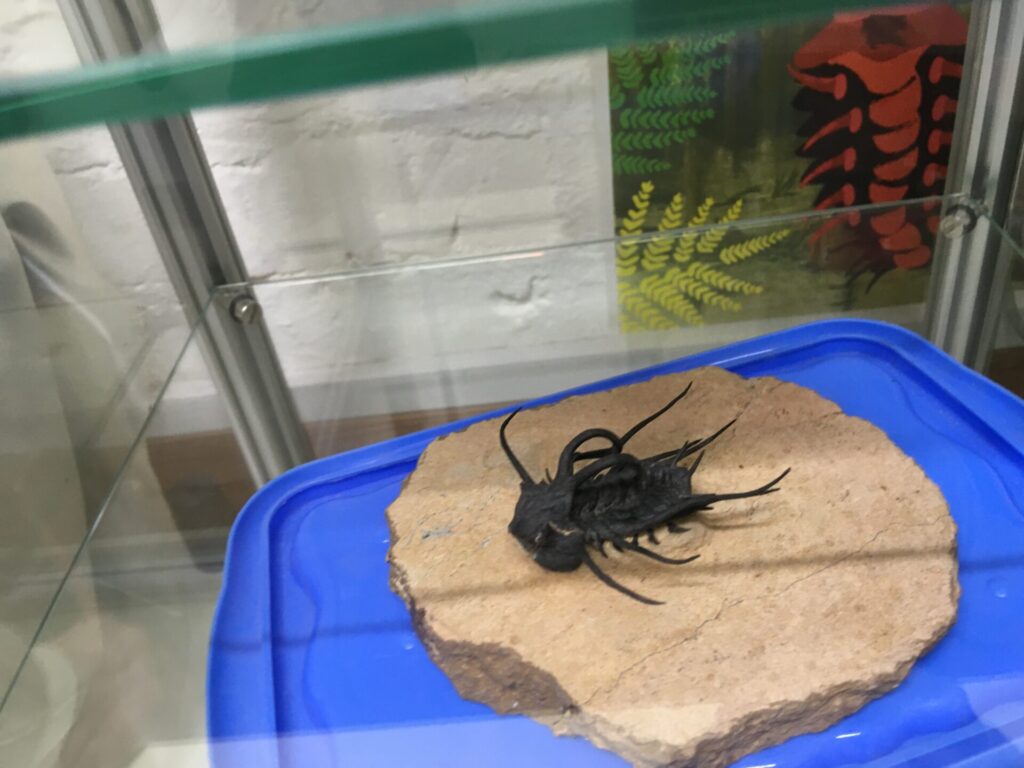
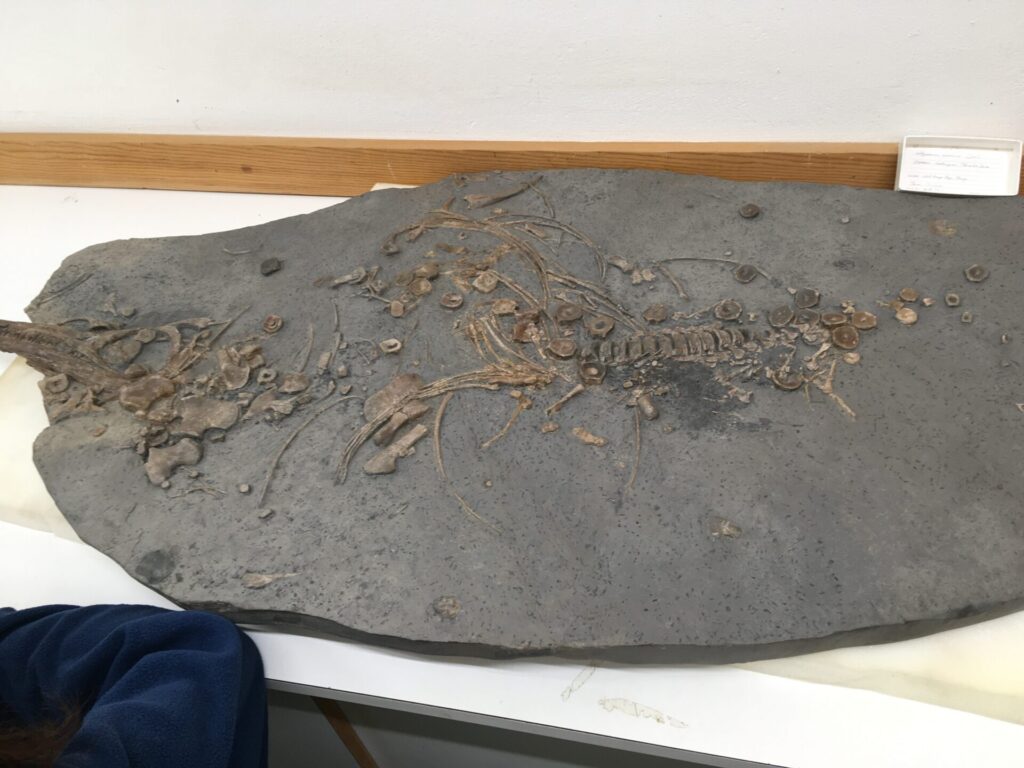
We were organised into small groups and given first a tour around the palaeontology collection held in the museum’s stores - see pictures + notes alongside. The last fossil photo is of the dinosaur footprint found in January 2021 on Bendricks Beach, Barry by a 4yr old girl, Lily was walking on the beach with her father. https://www.bbc.co.uk/news/uk-wales-55863928
To view a FULL IMAGE place your cursor over an image, then quickly DOUBLE CLICK "CTRL". With a FULL IMAGE displayed you can ZOOM into the image for further detail or move a zoomed image as required.
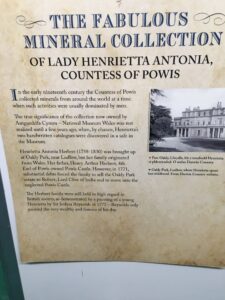
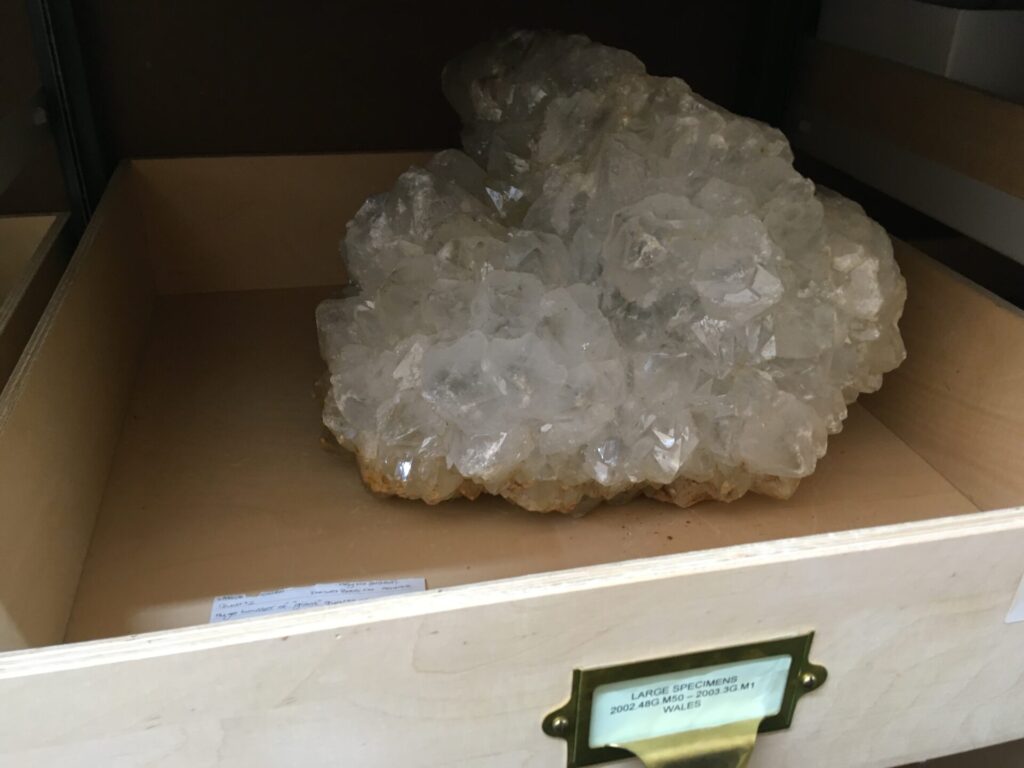
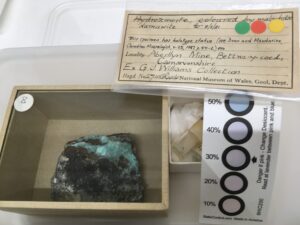
Then the second tour was to view the rock collections - hundreds of them stacked in drawers, row upon row, all breathtakingly beautiful - photos above of the prettiest - IMHO.
The afternoon was spent listening to the talks about the work that they were doing and their ideas to involve the public and promote interest in their field within the Geosciences umbrella to future generations. Recognising the urgency of the situation as year upon year funding is gradually being withdrawn from not only museums but also universities and schools so that the subject is no longer available to study.
Sarah and I thoroughly enjoyed the day and were most grateful to Cindy Howells for organising it. We both felt it a great privilege to be given access to the mineralogy and paleontology stores.
SH